
TABLE OF CONTENT38
SEO News & Intelligence: November 2026 – Google Core Updates, AI Search, Local SEO and the Future of Search
November 2026 has brought important developments across Google Search, AI-powered discovery, local search, technical SEO and search measurement. Google completed its November core update, announced a December core update ahead of its rollout, expanded Personal Intelligence in AI Mode and published new technical documentation for website owners. Meanwhile, Bing is experimenting with another AI-generated answer format.
For website owners, publishers, digital marketers and SEO professionals, these changes reinforce an important point: search visibility is no longer limited to traditional blue links. Businesses and publishers must build reliable websites, publish useful and distinctive information, maintain accurate business profiles and measure how audiences discover their content across multiple search experiences.
This November 2026 SEO intelligence report combines the major developments, explains what is confirmed and what remains experimental, and outlines practical actions for businesses and publishers in Nepal and international markets.
1. Google November 2026 Core Update Completed
Status: Confirmed – rollout completed
Google's November 2026 core update began on 10 November and completed on 24 November 2026, according to the Google Search Status Dashboard. The rollout lasted approximately 14 days and applied globally across languages.
Core updates are broad improvements to Google's ranking systems. They are not necessarily penalties against individual websites. Search visibility can change because Google's systems reassess the relevance and usefulness of content across the web.
What website owners should understand
Rankings may rise, fall or remain stable after a core update.
Changes can affect individual pages, sections or entire websites.
A ranking decline does not automatically mean a manual action or technical penalty.
Thin, repetitive, unhelpful or poorly differentiated content deserves closer review.
A website should be evaluated using search performance, user needs and business outcomes—not ranking positions alone.
Recommended actions
Compare Google Search Console performance before and after the rollout.
Review changes in clicks, impressions, average position and click-through rate.
Segment results by page, query, country, device and search appearance.
Identify which page groups gained or lost visibility.
Review content quality, search intent, originality and topical relevance.
Check indexing, canonical tags, internal links and technical accessibility.
Avoid making large-scale changes based only on short-term ranking fluctuations.
Google's general core update guidance recommends waiting until at least a full week after a rollout completes before conducting a meaningful post-update comparison. Allow for normal seasonal and market changes when interpreting the data.
Official status: https://status.search.google.com/
2. Google Preannounces the December 2026 Core Update
Status: Confirmed announcement – rollout not yet started
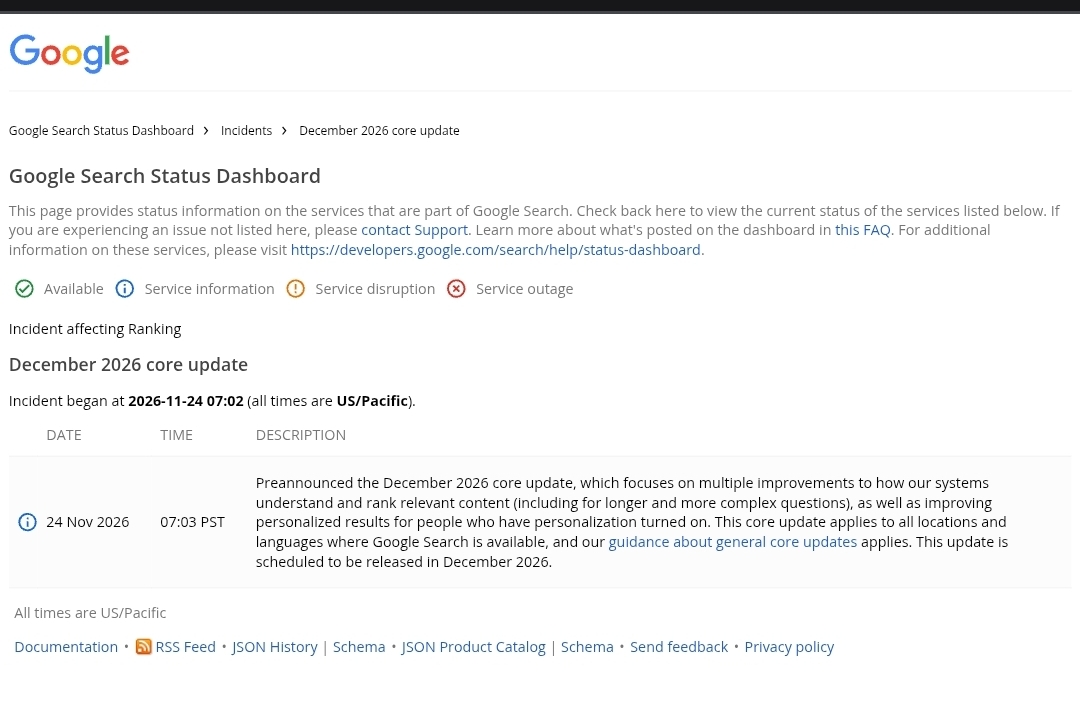
On 24 November, Google preannounced another core update scheduled for release in December 2026.
Google says the upcoming update will focus on improvements to how its systems understand and rank relevant content, including content addressing longer and more complex questions. It will also improve personalized results for people who have personalization enabled.
The announcement applies to all locations and languages where Google Search is available.
Why this matters
The announcement is particularly relevant to websites that publish informational, educational, news, service and specialist content. Longer and more complex searches often require detailed explanations, clear organization and trustworthy supporting information.
However, Google has not published a guaranteed ranking formula or a list of specific website changes that will secure better rankings.
What SEO professionals should do
Build content around real audience questions and search intent.
Explain complex subjects with accurate, well-organized information.
Demonstrate first-hand knowledge and relevant expertise.
Strengthen relationships between related pages through useful internal links.
Keep business, author and organization information consistent.
Monitor performance separately for branded, non-branded and long-tail queries.
Important: The December update was announced but was not live as of 25 November 2026. Do not describe it as an update that has already affected rankings.
3. Google AI Mode Expands Personal Intelligence
Status: Confirmed announcement – phased rollout
On 23 November, Google announced expanded Personal Intelligence capabilities in AI Mode.
The announcement introduces the option to connect Google Wallet to Personal Intelligence in AI Mode, with Google Drive and the Gemini app integrations expected to follow in the coming weeks. Users can choose whether to connect these services and manage their personalization settings.
Google says the aim is to make Search responses more relevant by using context that users have chosen to connect.
What this means for SEO
Search experiences are becoming more contextual. A person searching for a product, service, destination or solution may receive a response shaped by their previous activity and connected information.
This does not mean that traditional SEO has become irrelevant. It means businesses should make their information easy to understand, verify and connect with a user's actual needs.
Recommended content strategy
Answer specific questions clearly.
Publish detailed service, product and location information.
Use descriptive headings and logical content structures.
Include accurate facts, useful examples and supporting evidence.
Keep business information consistent across websites and trusted platforms.
Make important information accessible to users and search systems.
The practical opportunity is to create content that is genuinely useful beyond a single keyword or search result.
4. Google Business Profile: More Control Over Appointment and Reservation Links
Status: Reported feature update; check availability in individual profiles
Google Business Profile has introduced additional self-service controls for appointment booking and dining reservation links, according to industry reporting on Google's announcement.
The development follows earlier controls for restaurant food-ordering links. It gives eligible businesses more direct control over which third-party booking or reservation links appear on their profiles.
Google's Business Profile help documentation also explains how businesses can manage transaction links, add booking or reservation URLs and select a preferred link.
Why this matters for local SEO
For restaurants, hotels, clinics, spas, salons, fitness centers and other appointment-based businesses, booking links are an important part of the customer journey.
An inaccurate, outdated or unwanted booking link can create confusion and lost conversions.
Recommended actions for businesses
Open the Google Business Profile and review all booking or reservation links.
Confirm that each link leads to the correct business and booking destination.
Remove or replace outdated links where the controls are available.
Set the preferred booking or reservation link where appropriate.
Test the customer journey on mobile and desktop.
Check that the website, business profile and booking platform show consistent business information.
For restaurants, make sure reservation links, menus, opening hours, phone numbers and location information are accurate.
Official guidance: https://support.google.com/business/answer/6218037
5. Google Adds Documentation on Identifying Search Traffic
Status: Confirmed – official documentation published
On 12 November, Google added a Search Central documentation page explaining how website owners can identify traffic from Google Search using HTTP Referer headers.
The documentation explains which referrer values may be sent when a user clicks through from Google Search, how to identify those values in analytics systems or server logs, and why the resulting traffic numbers may not match Google Search Console.
Why this is important
Search Console and analytics platforms measure different things.
Search Console records search performance, including clicks from Google Search. Analytics systems measure visits or sessions after users reach a website and tracking systems record their activity.
Differences can occur because of:
Browser and operating-system privacy settings.
Missing or restricted referrer information.
Consent management and tracking restrictions.
Redirects that change or remove referrer information.
Different measurement methods between Search Console and analytics platforms.
Google also explains that the Referer header does not contain the search query. Search queries should still be reviewed through Search Console's Performance report.
Recommended actions
Review GA4 organic search channel configuration.
Check referral exclusions and custom channel rules.
Review server logs when investigating traffic discrepancies.
Preserve referrer information through redirects where appropriate.
Use Search Console for organic search queries and clicks.
Avoid treating GA4 sessions and Search Console clicks as identical metrics.
Official documentation: https://developers.google.com/search/docs/monitor-debug/identify-google-search-traffic/
6. Google Clarifies Its Back Button Hijacking Spam Policy
Status: Confirmed – documentation updated
Google added a
Frequently Asked Questions
Everything you need to know about Google Business Profile verification, local SEO, and multi-location management.
How does Dipak Paneru handle Google Business Profile video verification?
What is included in the AI Local SEO Audit?
Does Dipak Paneru support multi-location businesses across 195 countries?
Back button hijacking occurs when a website interferes with a visitor's expected browser navigation. Instead of returning to the previous page, the visitor may be redirected to an unexpected page, shown unwanted advertisements or prevented from navigating normally.
Google had already announced back button hijacking as an explicit spam-policy violation in April 2026. The November update adds further clarification through an FAQ section.
What website owners should check
Avoid scripts that manipulate browser history to trap visitors.
Do not redirect users to unexpected pages when they press Back.
Remove deceptive navigation and intrusive advertising practices.
Test browser navigation on mobile and desktop.
Review third-party scripts, advertising integrations and pop-up tools.
A good user experience includes giving visitors control over their browsing journey.
Official policy: https://developers.google.com/search/docs/essentials/spam-policies
7. Bing Tests a New AI-Generated Answer Format
Status: Industry observation – experimental test
On 24 November, Search Engine Roundtable reported a new AI-generated answer card appearing in Bing search results.
The card is labelled "AI-Generated answer" and appears separately from regular search listings. It includes a disclosure explaining that the answer was generated using AI from multiple online sources, with links for users to view original source information.
The reported format appears distinct from Bing's existing AI Overviews and Copilot Search experiences. However, Microsoft has not confirmed a general rollout or fully explained the experiment.
Why publishers should pay attention
AI-generated answers can change how people discover information. A user may receive a summary before deciding whether to visit an individual website.
For publishers, this makes accurate information, clear attribution and useful source material increasingly important.
Recommended actions
Publish original reporting and first-hand information.
Use descriptive headlines and informative page titles.
Make factual claims easy to verify.
Include relevant sources and references.
Maintain clear author, publisher and publication-date information.
Monitor referral traffic and search visibility across available platforms.
Do not assume that appearing in one AI search feature guarantees visibility in another. Each platform may use different systems and sources.
8. Bing Gives Users More Choice Over AI Search
Status: Confirmed – Microsoft announcement
Microsoft published an announcement on 11 November describing options for users who want to search Bing with or without AI-generated answers.
The company highlighted its approach of providing both AI-powered and traditional search experiences, including a preview browser extension that allows users to control whether AI features appear.
SEO implications
Search engines are experimenting with different ways to present information. Some users may prefer direct answers, while others want to compare traditional search results and visit websites themselves.
Businesses and publishers should therefore avoid depending on only one type of search presentation.
Recommended actions
Maintain technically accessible and crawlable websites.
Use descriptive titles and useful page summaries.
Publish original information rather than generic rewritten content.
Monitor Bing Webmaster Tools alongside Google Search Console.
Build brand recognition beyond search engines through direct audiences and trusted platforms.
Microsoft announcement: https://blogs.bing.com/search/2026/11/your-choice-turn-ai-answers-on-or-off-in-bing/
9. Technical SEO: Documentation, Crawling and Website Quality
Google's November documentation updates also provide practical reminders for technical SEO teams.
The Search Central documentation changelog includes:
23 November: Added an FAQ to the back button hijacking spam policy.
18 November: Removed the discontinued Data Feed validation tool from the book actions documentation.
12 November: Added guidance for identifying Google Search traffic using HTTP Referer headers.
9 November: Added support for "things to do" queries to aggregator and supplier unit documentation.
These changes do not represent a single new ranking algorithm. They are documentation and feature-related updates that website owners, publishers and developers should understand where relevant.
Technical SEO checklist
Crawling and indexing
Review robots.txt and XML sitemaps.
Check canonical tags and indexability.
Resolve accidental noindex directives.
Monitor crawl errors and indexing changes.
Ensure important pages are accessible through internal links.
Website performance
Monitor Core Web Vitals.
Improve Largest Contentful Paint and Interaction to Next Paint.
Reduce unnecessary JavaScript and render-blocking resources.
Optimize images and font delivery.
Test mobile usability and responsive layouts.
Structured data
Use schema that accurately describes visible page content.
Validate JSON-LD implementation.
Review relevant Article, Organization, LocalBusiness, Product, Event and VideoObject properties.
Avoid misleading or unsupported structured data.
Monitor rich-result eligibility and errors.
Security and user experience
Maintain HTTPS.
Remove intrusive or deceptive navigation.
Review third-party scripts and integrations.
Test forms, menus, booking journeys and mobile navigation.
Official documentation updates: https://developers.google.com/search/updates
10. Structured Data and Entity SEO Remain Important
Structured data continues to help search systems interpret the entities, products, organizations, services and content represented on a website.
For local businesses, accurate business information can support a clearer understanding of the business and its services. For publishers, appropriate Article and Organization markup can help describe editorial content and its source.
Recommended schema implementation
Website type | Relevant structured data |
|---|---|
News publisher | NewsArticle, Article, Organization |
Local business | LocalBusiness, Organization |
Restaurant | Restaurant, LocalBusiness, Menu |
Hotel | Hotel, LodgingBusiness |
Software company | Organization, SoftwareApplication, Product |
Service provider | Organization, Service |
Video publisher | VideoObject |
Event organizer | Event, Organization |
Schema markup must reflect information that is genuinely present on the page. Adding structured data does not guarantee a rich result or improved ranking.
Entity consistency checklist
Use one consistent official business name.
Maintain accurate website and contact information.
Keep location details consistent across relevant profiles.
Connect official social media accounts.
Publish clear About, Contact and service pages.
Identify authors and editorial responsibilities.
Use relevant structured data without inventing attributes.
For businesses seeking stronger brand recognition, entity consistency should be treated as an ongoing digital presence strategy rather than a one-time schema installation.
11. What These Developments Mean for Nepal's Digital Market
The November updates are relevant to Nepalese businesses, tourism operators, software companies, news publishers, educational institutions and digital agencies.
As more people use AI-assisted search and mobile-first discovery, businesses need to make their information accurate, useful and accessible across digital platforms.
For Nepalese local businesses
Restaurants, hotels, travel companies, spas, clinics and other service providers should prioritize:
Accurate Google Business Profile information.
Correct map location, opening hours and contact details.
Relevant categories and service descriptions.
Updated booking and reservation links.
Original photographs and useful website content.
Genuine customer reviews and professional responses.
Consistent business information across directories.
For Nepalese news publishers
News websites should focus on:
Original reporting and editorial credibility.
Clear publication and modification dates.
Named authors and transparent editorial information.
Accurate headlines that reflect article content.
Strong mobile performance.
Proper news sitemaps and structured data.
Reliable source attribution and fact-checking.
Clear topic categories and internal linking.
Publishers should not assume that publishing more articles automatically creates stronger search visibility. Editorial quality, originality, reader value and technical reliability remain essential.
For Nepalese software and technology companies
Technology companies targeting Nepal and international markets should build detailed pages for:
Software development services.
Web and mobile application development.
SaaS products and software platforms.
Industry-specific solutions.
Product features, use cases and documentation.
Company expertise, team and contact information.
A strong digital presence should clearly explain what the company provides, who it serves, where it operates and how customers can verify its expertise.
For SEO agencies and digital marketers
Agencies should expand reporting beyond keyword rankings. A useful performance framework should include:
Organic clicks and impressions.
Qualified website traffic.
Leads, calls and booking conversions.
Local search visibility.
Brand and entity consistency.
Referral traffic from search and AI platforms where measurable.
Technical health and content quality.
AI visibility should be reported using accessible evidence and repeatable observations—not invented percentages or unsupported claims about how often a brand appears in private AI conversations.
12. Practical SEO Action Plan: What to Do Next
The following priorities translate November's developments into practical work for website owners, developers, publishers and marketing teams.
Priority | Action | Expected benefit |
|---|---|---|
High | Review November core update performance in Search Console | Identify affected pages and queries |
High | Prepare for the December core update | Improve content and technical quality |
High | Verify business profile information and booking links | Reduce customer friction |
High | Check crawling, indexing and canonical settings | Protect search accessibility |
High | Review mobile performance and Core Web Vitals | Improve user experience |
Medium | Audit GA4 and Search Console measurement differences | Improve reporting accuracy |
Medium | Validate structured data | Improve content understanding |
Medium | Strengthen author and organization information | Improve transparency and entity clarity |
Medium | Monitor Bing and AI search experiments | Understand emerging discovery channels |
Ongoing | Publish original, useful and well-researched content | Build long-term authority |
A simple 30-day implementation approach
Week 1: Search performance review
Export Search Console data.
Compare pre-update and post-update performance.
Identify affected pages, queries and page groups.
Check whether changes are isolated or site-wide.
Week 2: Technical SEO
Review indexing and crawl accessibility.
Test mobile performance.
Check redirects, canonicals and XML sitemaps.
Review structured data and critical errors.
Week 3: Content and entity improvement
Improve pages that do not adequately satisfy user intent.
Add original information and relevant supporting evidence.
Improve internal linking.
Review business, author and organization details.
Week 4: Local SEO and measurement
Audit Google Business Profile information.
Test booking and reservation journeys.
Review GA4 channel configuration.
Establish a repeatable search and conversion reporting process.
13. Final Outlook: SEO in 2026 Is About More Than Rankings
November 2026 demonstrates how quickly search is evolving. Google's core updates, AI Mode personalization, Business Profile controls and technical documentation changes all affect different parts of the search ecosystem. Bing's experiments show that AI-generated answers are also becoming a more visible part of search discovery.
However, the fundamentals remain important.
A successful website needs useful content, a technically reliable foundation, clear business or publisher identity, trustworthy information and a good user experience. AI search optimization, GEO and AEO should strengthen these foundations—not replace them.
For businesses and publishers in Nepal, the opportunity is to build digital assets that can serve local audiences while remaining understandable and useful to international searchers.
The best long-term SEO strategy is not to chase every algorithm change. It is to build a website and digital presence that consistently deserves to be discovered, trusted and chosen.
Official Resources and Further Reading
Google Search Status Dashboard: https://status.search.google.com/
Google Search Central – Latest Documentation Updates: https://developers.google.com/search/updates
Google – Personal Intelligence in AI Mode: https://blog.google/products-and-platforms/products/search/google-search-personal-intelligence-apps/
Google – Identify Search Traffic in Analytics and Logs: https://developers.google.com/search/docs/monitor-debug/identify-google-search-traffic/
Google Business Profile – Manage Business Links: https://support.google.com/business/answer/6218037
Google Search Spam Policies: https://developers.google.com/search/docs/essentials/spam-policies
Microsoft Bing – AI Search Choice: https://blogs.bing.com/search/2026/11/your-choice-turn-ai-answers-on-or-off-in-bing/
Editorial note: Official Google and Microsoft announcements and documentation are distinguished from third-party reports of experimental search features. Bing's standalone AI-generated answer card remains an observed test, not a confirmed general release. The December 2026 Google core update had been announced but had not started rolling out as of 25 November 2026.