
TABLE OF CONTENT59
How Can Businesses Get Discovered on ChatGPT?
The way people discover businesses online is changing. Traditionally, customers used Google, Bing, business directories, social media platforms, and review websites to find companies, compare services, and make purchasing decisions. Today, AI-powered platforms are introducing another way to discover products, services, and businesses.
People increasingly use conversational AI to ask questions such as:
Which software development company can build a business application?
What are the best restaurants near my location?
Can you recommend a reliable digital marketing agency?
Which company provides affordable website development?
What businesses offer services in my city?
Where can I compare products before making a purchase?
These questions represent a growing opportunity for businesses to improve their visibility across AI-powered discovery platforms.
On November 10, 2026, OpenAI announced Businesses in ChatGPT, introducing Business Hub and Business Agents. The announcement provides businesses with new ways to manage their information, understand how people engage with them through ChatGPT, and, for eligible organizations, interact with potential customers through business-specific AI agents.
This development is important for business owners, digital marketers, SEO professionals, software companies, ecommerce businesses, restaurants, service providers, and organizations interested in AI search visibility.
However, appearing in ChatGPT is not simply a matter of registering a business or adding keywords to a website. Businesses still need accurate information, useful content, a trustworthy online presence, and clear information about their products and services.
This guide explains what OpenAI Business Hub means, how business discovery in ChatGPT works, and how companies can prepare their digital presence for the future of AI-powered search.
What Is Businesses in ChatGPT?
Businesses in ChatGPT is an OpenAI initiative designed to create more ways for businesses to connect with people using ChatGPT.
According to OpenAI's announcement, the new experience introduces tools that help businesses:
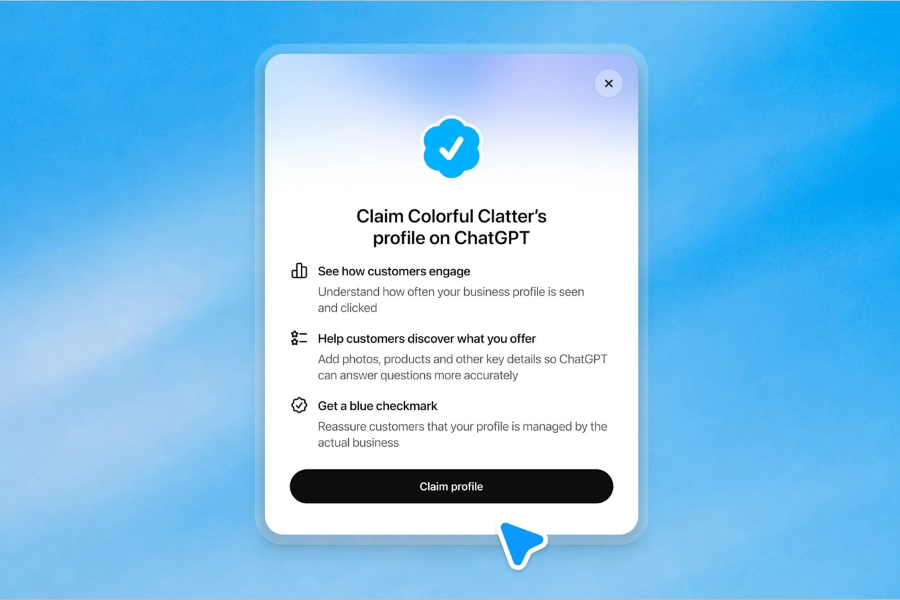
Claim their business through Business Hub.
Verify their business information.
Manage important business details.
Add self-service product feeds where eligible.
Understand aggregated business mentions and website clicks.
Explore discovery topics associated with website citations.
Build and launch Business Agents when eligible.
OpenAI describes ChatGPT as serving 1.2 billion people each week in the announcement. This demonstrates the potential scale of AI-powered business discovery.
The initiative is an early step toward making it easier for customers to discover businesses, explore their offerings, compare options, and interact with organizations.
For businesses, this creates a new consideration in digital marketing: how can customers find accurate information about a company when they ask an AI assistant rather than entering a traditional search query?
What Is OpenAI Business Hub?
OpenAI Business Hub is the business-facing experience introduced as part of Businesses in ChatGPT.
It allows eligible organizations to claim their business, manage business information, and access aggregated insights into how people engage with them in ChatGPT.
How does Business Hub work?
The process begins with a business claiming its organization through Business Hub.
Once verified, eligible businesses can manage important information and, where supported, add self-service product feeds containing product pricing and availability.
This gives ChatGPT another way to access accurate and up-to-date business and product information.
Business Hub also provides aggregated insights, including business mentions, website clicks, and discovery topics. These topics describe common themes across conversations where a business website is cited.
This information can help businesses understand how their online presence is being discovered and identify opportunities to improve the information they publish.
Who can claim a business in ChatGPT?
OpenAI states that eligible businesses located in regions where ChatGPT is available can claim their business through Business Hub.
There are also specific arrangements for certain organizations:
Existing OpenAI Enterprise customers and advertisers can work with their OpenAI representatives.
Shopify merchants can connect their stores through Business Hub or the Shopify administration experience.
Eligible Shopify products are already integrated into ChatGPT through Shopify Catalog.
Eligibility and availability may vary. Businesses should check OpenAI's official documentation and Business Hub rather than assuming every feature is available in every country or business category.
How Does ChatGPT Help People Discover Businesses?
Traditional search often begins with a short keyword, such as "software company in Nepal" or "best seafood restaurant in Portugal."
Conversational AI allows users to describe their requirements in greater detail.
For example, a user might ask:
"Find a software development company that builds custom HR management systems, mobile applications, and enterprise web platforms for international clients."
An AI assistant can help the user explore relevant information, compare options, and identify businesses that may meet the requirements.
Business discovery through AI can involve several types of information:
1. Business information
A business needs a clear and consistent identity across its website and relevant online platforms. This includes its official name, location, contact details, services, operating areas, and business description.
2. Products and services
Customers need to understand what a business actually offers. Detailed service pages, product descriptions, pricing information where appropriate, and accurate availability information help explain the company's offerings.
3. Website content
Useful website content helps explain a business's expertise, solutions, industry knowledge, and experience.
4. External business references
Business directories, professional profiles, relevant publications, industry websites, and other credible references can contribute to a more complete public understanding of an organization.
5. Customer experience and reputation
Reviews, customer feedback, service information, and consistent business details help people evaluate whether a company is suitable for their needs.
These are sensible foundations for digital discoverability, but they do not guarantee that ChatGPT will mention or recommend a particular business.
What Are ChatGPT Business Agents?
Business Agents are another important part of OpenAI's announcement.
After claiming their business in ChatGPT, eligible organizations can build, test, and launch a Business Agent.
A Business Agent can help customers explore a company's products and services through a conversation.
For example, someone comparing two software products might ask about their differences, features, and suitability for a particular business requirement.
A Business Agent could help explain those offerings using the business's information.
How do Business Agents work?
OpenAI describes an experience in which a customer can view a business profile when a business appears in a model response. If that business has a Business Agent, the customer may choose to begin a separate conversation with it.
This gives businesses a way to provide additional information to interested customers.
Potential applications include:
Explaining product features.
Answering questions about services.
Helping customers compare offerings.
Providing information about business solutions.
Guiding customers through available options.
Supporting product and service exploration.
Are Business Agents the same as ChatGPT recommendations?
No. This distinction is important.
A Business Agent is a business-controlled conversational experience. OpenAI explains that the agent conversation is clearly labelled and separate from ChatGPT's independent answers.
A business should not confuse its own Business Agent with an independent recommendation from ChatGPT.
OpenAI also says businesses can sponsor their Business Agents and use them as destinations for ChatGPT Ads. Sponsored placements are clearly labelled and separate from ChatGPT responses.
Which businesses can use Business Agents?
At the time of OpenAI's November 10, 2026 announcement, Business Agents were available to eligible ecommerce and online service businesses in the United States.
OpenAI says it plans to expand Businesses in ChatGPT and Business Agents to additional markets and business categories over time.
Businesses outside the currently supported categories or regions should not assume immediate access.
Why AI Search Visibility Matters for Businesses
AI search visibility describes how easily a business's information can be discovered, understood, and represented across AI-powered search and conversational systems.
Customers may use ChatGPT, Perplexity, Google AI Overviews, Microsoft Copilot, and other AI-powered experiences to research products, services, and companies.
This does not mean traditional SEO is no longer important. Search engines remain essential channels for discovering websites and businesses.
Instead, businesses should build a digital presence that works across traditional search engines, local search, directories, and AI-powered discovery experiences.
What is Generative Engine Optimization (GEO)?
Generative Engine Optimization, commonly called GEO, is the practice of improving digital content and business information so that it can be understood and potentially referenced by generative AI systems.
A practical GEO strategy focuses on:
Publishing accurate and useful information.
Answering relevant customer questions.
Explaining products and services clearly.
Demonstrating real expertise.
Maintaining consistent business information.
Building credible references across the web.
Structuring content so that important details are easy to understand.
GEO should not be treated as a guaranteed method for obtaining AI citations or recommendations. AI platforms use their own systems, data sources, retrieval methods, and ranking processes.
What is Answer Engine Optimization (AEO)?
Answer Engine Optimization, or AEO, focuses on making content useful for systems that provide direct answers to questions.
For example, instead of publishing a page that only repeats "best software company," a company can answer questions such as:
What does a software development company do?
How much does custom software development cost?
What is the difference between SaaS and custom software?
How do businesses choose an enterprise software provider?
What should a company consider before developing a mobile application?
Clear explanations, descriptive headings, concise answers, and reliable supporting information make content more useful to readers and answer-oriented search experiences.
What is AI SEO?
AI SEO combines established search engine optimization practices with an understanding of how AI-powered platforms interpret and present information.
A practical AI SEO strategy includes:
Technical SEO and crawlability.
High-quality, original content.
Search intent and semantic relevance.
Structured data where appropriate.
Local SEO and consistent business information.
Relevant external references and digital authority.
Clear product and service descriptions.
Performance, accessibility, and user experience.
AI SEO should strengthen the quality of a company's overall digital presence rather than replace fundamental SEO practices.
How to Prepare Your Business for ChatGPT Discovery
Businesses interested in appearing in AI-powered search experiences should start with the information customers need to understand them.
The following steps provide a practical foundation.
1. Build a complete official business website
Your website should clearly explain:
Who your business is.
What products and services you provide.
Which industries you serve.
Where you operate.
How customers can contact you.
What makes your company different.
What experience and expertise your team offers.
Create dedicated pages for important services instead of placing every offering into one general page.
For example, a software company may need separate pages for custom software development, mobile application development, web application development, HR management software, and cloud-based solutions.
2. Maintain accurate business information
Keep your company name, website, address, telephone number, business description, and operating information consistent wherever the business is represented.
Review your Google Business Profile and other relevant business listings regularly.
For local companies, accurate business hours, categories, service areas, contact details, and service descriptions are especially important.
3. Create useful, specific service pages
A service page should explain what the business provides, who it serves, how the service works, and what customers can expect.
Avoid generic descriptions that could apply to hundreds of companies.
For example, a custom software development page can explain its development process, technology stack, integration capabilities, security considerations, support arrangements, and relevant project experience.
4. Publish original, helpful content
Create content that answers real questions from customers.
Useful formats include:
Detailed service guides.
Product comparisons.
Industry explainers.
-
.
Frequently Asked Questions
Everything you need to know about Google Business Profile verification, local SEO, and multi-location management.
How does Dipak Paneru handle Google Business Profile video verification?
Dipak provides a 5-point verification preparation protocol inspecting business premises, exterior signage, equipment, and registration documents before initiating the live video verification stream. This yields a 100% verification success rate across Nepal, Portugal, Japan, and international markets.What is included in the AI Local SEO Audit?
Our audit methodology inspects Schema.org JSON-LD microdata, EXIF geo-coordinates, and regional citation consistency across top country directories.Does Dipak Paneru support multi-location businesses across 195 countries?
Yes, Dipak provides multi-location NAP synchronization, geo-targeted landing page creation, and regional directory submission protocols tailored for multi-location enterprise brands worldwide. Case studies.
Technical documentation.
Practical tutorials.
Business insights and research.
Content should demonstrate real knowledge rather than simply repeat keywords.
5. Strengthen your digital authority
Businesses should build credible references across relevant websites and professional platforms.
Potential sources include:
Industry-specific directories.
Professional business profiles.
Relevant publications.
Genuine customer testimonials.
Business association websites.
Relevant interviews and media coverage.
Credible partner and supplier websites.
Original research and useful resources.
The quality and relevance of references matter more than simply accumulating a large number of listings.
6. Use structured data correctly
Schema.org structured data can help search engines interpret information about an organization, its services, products, articles, and other entities.
Depending on the website, relevant types may include:
Organization
LocalBusiness
ProfessionalService
Product
Service
Article
BreadcrumbList
Person
Only use structured data that accurately represents visible page content and the actual organization.
Structured data is not a guarantee of higher rankings, AI citations, or ChatGPT recommendations. It is one part of a well-organized website.
7. Make your website technically accessible
Technical SEO supports the discovery and usability of website content.
Review:
XML sitemap availability.
Robots.txt configuration.
Canonical URLs.
Indexability.
Mobile responsiveness.
Page speed and Core Web Vitals.
HTTPS security.
Broken links and redirects.
Image optimization.
Internal linking.
Accessibility.
Server reliability.
Do not block search or AI crawlers indiscriminately. Review the documentation and access policies of each platform before changing crawler permissions.
8. Make product information understandable
If you sell products online, provide accurate product names, descriptions, prices, availability, images, and relevant attributes.
For eligible businesses, OpenAI's announcement describes the ability to add product feeds through Business Hub. Shopify merchants also have specific integration options.
Product information should be maintained at its source so that customers do not encounter outdated prices or unavailable items.
Local SEO and AI-Powered Business Discovery
Local businesses have an additional opportunity to improve how customers find them.
Someone may ask an AI assistant:
What is the best restaurant near Lakeside Pokhara?
Which spa offers premium massage services in Pokhara?
Where can I find a software company in Nepal?
Which travel agency provides tour packages in Pokhara?
What are the best seafood restaurants in Portugal?
These questions involve location, business category, service relevance, and customer requirements.
A practical local SEO strategy includes:
Google Business Profile: Maintain accurate categories, business hours, contact details, services, photographs, and location information.
Local landing pages: Explain the services available in the actual locations the business serves.
Consistent citations: Keep business details accurate across relevant directories and platforms.
Customer reviews: Encourage genuine feedback and respond professionally. Never purchase reviews or manipulate ratings.
Local content: Publish useful information about services, products, customers, and the communities the business genuinely serves.
Location relevance: Do not create misleading location pages or claim offices in places where the company has no legitimate presence.
Local SEO can support overall discoverability, but no individual listing or ranking guarantees an AI recommendation.
How to Measure Your Business's AI Search Visibility
One of the most interesting parts of OpenAI's Business Hub announcement is the introduction of aggregated business insights.
According to OpenAI, these can include:
The number of business mentions.
Website clicks received.
Discovery topics across conversations where the business website is cited.
These insights can help eligible businesses understand how people engage with their information in ChatGPT.
OpenAI also emphasizes privacy. It does not share users' conversations or Business Agent chats with businesses. Insights are aggregated and are only made available when sufficient interactions meet certain thresholds.
Businesses can complement these insights with their own measurement systems.
Recommended AI visibility measurement
Track the following indicators where reliable data is available:
Measurement | What it helps explain |
|---|---|
ChatGPT business mentions | Whether a business is appearing in available business insights |
Website clicks | Visits generated through ChatGPT experiences |
Discovery topics | Themes associated with website citations |
Organic search traffic | Search engine visibility and visits |
Branded search demand | Interest in the company name |
Referral traffic | Visits from identifiable external platforms |
Conversion rate | Whether visitors become enquiries or customers |
Qualified leads | Whether visibility generates relevant business opportunities |
Use consistent reporting periods and distinguish measured results from estimates.
Do not treat a manually tested AI response as proof of universal visibility. AI answers can vary by prompt, location, time, context, and platform.
Common Mistakes Businesses Should Avoid When Trying to Appear in ChatGPT
AI search visibility has attracted considerable attention, but businesses should avoid shortcuts and unsupported promises.
Keyword stuffing
Repeating phrases such as "best company," "top business," and "number one service provider" does not establish expertise or guarantee AI recommendations.
Fake business listings
Creating false addresses, duplicate profiles, or misleading company identities can damage trust and create local search problems.
Low-quality backlinks
Buying irrelevant links or creating large numbers of low-quality directory entries is not a sustainable digital authority strategy.
Misleading AI claims
No consultant or agency should promise guaranteed placement in ChatGPT, Perplexity, Google AI Overviews, or other independent AI systems.
Confusing paid promotion with organic discovery
Sponsored placements and independent AI responses are different. Businesses should understand the difference between advertising, business-controlled agents, and independent recommendations.
Publishing content without evidence
Avoid fabricated case studies, invented customer reviews, unsupported performance claims, and unverified business information.
Long-term discoverability depends on providing useful, accurate, and trustworthy information.
What Does OpenAI Business Hub Mean for Businesses in Nepal and Global Markets?
OpenAI's announcement is relevant to businesses around the world, including organizations in Nepal that serve international customers.
A Nepal-based software company, tourism business, digital marketing agency, ecommerce brand, or professional service provider may have customers searching for solutions across multiple countries.
For these companies, a strong digital presence should explain both their business identity and the markets they genuinely serve.
For example, a software development company in Pokhara may work with clients in Nepal, the United Kingdom, Portugal, the United States, and other international markets.
Its website should clearly communicate:
Its official business location.
Its international service capabilities.
Its actual products and services.
Its technology expertise.
Its customer support arrangements.
Its portfolio and verifiable experience.
Its contact and enquiry channels.
Businesses in Nepal should monitor OpenAI's official Business Hub availability and eligibility information. The announcement describes eligibility for businesses in locations where ChatGPT is available, but particular features, integrations, and Business Agent access may have additional restrictions.
The opportunity is not limited to registering with a platform. It is also about building a credible digital identity that customers and discovery systems can understand.
The Future of Business Discovery: Search Engines, AI Assistants and Business Agents
Business discovery is moving beyond a simple list of website links.
Customers may discover a company through a search engine, compare its services using an AI assistant, visit its website, read independent reviews, and then interact with a business-specific agent.
This creates several connected areas of digital marketing:
Traditional SEO: Helping websites appear in relevant search engine results.
Local SEO: Improving visibility for location-based searches and nearby services.
GEO: Making content more useful and understandable for generative AI experiences.
AEO: Providing clear, relevant answers to customer questions.
AI SEO: Building a strong overall presence across search and AI-powered discovery systems.
Digital PR and authority: Establishing credible external references and a recognizable business identity.
Conversion optimization: Helping visitors take meaningful actions after discovering a company.
These activities should work together. A business does not need to abandon traditional SEO to prepare for AI discovery. It needs to make its digital presence more useful, accurate, and understandable.
Frequently Asked Questions About ChatGPT Business Discovery
1. Can businesses appear in ChatGPT search results?
Yes. Businesses may be surfaced in ChatGPT experiences when relevant to a user's question. OpenAI's Businesses in ChatGPT initiative introduces additional business information and discovery experiences. However, no business is guaranteed to appear for every relevant query.
2. What is OpenAI Business Hub?
OpenAI Business Hub is a business-facing experience that allows eligible organizations to claim their business, manage information, and access aggregated insights into how people engage with them in ChatGPT.
3. How can I claim my business on ChatGPT?
Eligible businesses can use the official OpenAI Business Hub experience to claim their organization and complete the required verification process. Availability and eligibility depend on OpenAI's requirements.
4. Is Business Hub available in Nepal?
OpenAI's announcement says eligible businesses located where ChatGPT is available can claim their business. However, individual features and integrations may have additional eligibility requirements. Check the official Business Hub for current availability.
5. What is a ChatGPT Business Agent?
A Business Agent is a business-specific conversational experience that eligible organizations can build, test, and launch to help customers explore their products and services.
6. Does registering a business guarantee ChatGPT recommendations?
No. Claiming a business helps eligible organizations manage information through Business Hub. It does not guarantee organic recommendations, rankings, mentions, or citations in ChatGPT.
7. What is the difference between GEO and traditional SEO?
Traditional SEO focuses on improving a website's visibility in search engines. GEO focuses on making information useful and understandable in generative AI experiences. Both benefit from accurate information, quality content, and a technically accessible website.
8. Does schema markup help businesses appear in ChatGPT?
Structured data can help supported search systems interpret information about a website and its entities. However, adding schema does not guarantee that ChatGPT will cite or recommend a business.
9. How can small businesses improve AI search visibility?
Small businesses can begin by creating a complete website, maintaining accurate business listings, publishing helpful service information, collecting genuine customer feedback, and building relevant digital references.
10. Can Business Agents advertise on ChatGPT?
OpenAI says businesses can sponsor their Business Agents and use them as destinations for ChatGPT Ads. Sponsored placements are clearly labelled and separate from ChatGPT responses.
11. Does ChatGPT share customer conversations with businesses?
OpenAI says Business Hub insights are aggregated and designed to protect user privacy. It does not share users' conversations or Business Agent chats with businesses through these insights.
12. Is AI SEO replacing Google SEO?
No. Search engines remain important for discovering websites, products, and services. AI SEO and GEO should complement established technical, on-page, off-page, and local SEO practices.
13. How do I know whether my business is visible in AI search?
Use platform-provided business insights where available, review referral traffic, monitor relevant search performance, and conduct repeatable tests with representative customer questions. Separate observed evidence from assumptions.
14. Can a business outside the United States use Business Agents?
At the time of OpenAI's November 10, 2026 announcement, Business Agents were available to eligible ecommerce and online service businesses in the United States. OpenAI plans to expand availability, but businesses should check current eligibility rather than assume access.
15. What should businesses do first to prepare for AI-powered discovery?
Start with accurate business information, a technically accessible website, clear product and service pages, helpful content, genuine reputation signals, and reliable measurement. These are practical foundations for both traditional search and AI discovery.
Conclusion: Build a Business That Can Be Discovered Across Search and AI Platforms
OpenAI's introduction of Businesses in ChatGPT represents an important development in how businesses may connect with customers through AI-powered experiences.
Business Hub provides eligible organizations with tools to claim and manage their information and understand aggregated engagement. Business Agents introduce another way for eligible companies to help customers explore products and services through conversation.
For business owners, the practical lesson is clear: digital visibility requires more than publishing a website and inserting keywords.
Businesses need accurate information, clear services, useful content, technical accessibility, genuine reputation signals, and a credible online presence.
SEO, local SEO, GEO, AEO, AI SEO, and digital authority should work together to make a business easier to understand and discover.
No platform can guarantee that a business will be recommended by every AI assistant. But organizations that invest in useful information, transparency, and a strong digital foundation will be better prepared as search and business discovery continue to evolve.
The future of business discovery is not only about ranking on search engines. It is about helping people understand what your business offers, why it matters, and how they can connect with you.
Official Source
OpenAI — Introducing Businesses in ChatGPT, November 10, 2026.
This is the primary source for the Business Hub, business claiming, aggregated insights, Business Agents, and the availability details described in this article.
Editorial note: OpenAI product availability and eligibility can change. Review the official announcement and Business Hub before publishing updates to this article.